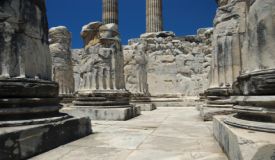
Didyma, a sacred site, is near Didim village in modern-day Turkey. The name Didyma is believed to refer to the twins, namely Artemis and Apollo. It is a well-known oracle in Hellenistic culture. Didyma was a sanctuary rather than a city, and it was visited for prophecy rituals mainly by the inhabitants of Miletus, located just 20 km away, or by pilgrims coming from other regions of the Aegean territory. The road that connected Miletus and Didyma was called the Sacred Way.
Didyma is famous for its Temple of Apollo, which was one of the biggest Hellenistic temples. The building date goes back to the 4th century BC, but research indicates that it may be much older than that. It is known today that it has been destroyed and reconstructed more than once. In fact, the latest additional construction attempts in the Roman and Byzantine eras did not succeed. A very photogenic Medusa head carved of marble, which appears in tourism brochures of Turkey, still sits among the ruins.
Didyma dates back to at least the 8th century BC.
The sanctuary was dedicated to Apollo, god of prophecy, music, and healing.
The oracle of Didyma was consulted by kings and city-states from across the Mediterranean.
The Sacred Way connected Didyma to Miletus, lined with statues and offerings.
The Persians destroyed the temple in 494 BC.
Alexander the Great reconquered the region, and reconstruction began in the 4th century BC.
The temple was never fully completed. Construction continued into the Roman period but was abandoned.
The Medusa head is one of the few surviving decorative elements from the unfinished construction.
An early Christian church was built inside the ruins, and the site was later abandoned.
The Temple of Apollo at Didyma is one of the largest Hellenistic temples ever built.
It measured approximately 118 meters by 60 meters.
The temple had 122 columns, each over 19 meters tall.
Only three columns still stand today, but their size gives a sense of the original scale.
The temple was dipteral, meaning it had two rows of columns on all sides.
The inner sanctuary (adyton) was open to the sky and contained a small temple and a sacred spring.
A monumental staircase led to the inner sanctuary.
The Medusa head is located on the side of the temple.
Entrance Fee: Approximately 100-150 TL (separate from Miletus and Priene). Museum Pass Turkey is accepted.
Opening Hours: Daily 8:30 AM to 7:00 PM (summer), 8:30 AM to 5:00 PM (winter).
Best time to visit: Spring (April-June) and autumn (September-October) offer mild weather. Summer (July-August) is very hot (35-40°C). Visit early morning or late afternoon to avoid the midday heat.
How to get there: Didyma is located near the modern town of Didim (also called Yenihisar), about 100 km from Kuşadası (1.5 hours), 160 km from Bodrum (2.5 hours), and 20 km from Miletus. The best way to visit is by rental car or with a guided tour. Minibuses (dolmuş) run from Didim town center to the site. You can also use a private Izmir Airport Transfer or Bodrum Airport Transfer.
What to bring: Water, sunscreen, hat, and comfortable walking shoes. There is little shade at the site.
Facilities: A small cafe and gift shop near the entrance. Toilets are available.
You can access these three sites from Kuşadası (about 100 km) or Bodrum (about 160 km). Tours from Istanbul and daily tours from Izmir are also available.
Please see our tour page for all tours in this region and around Turkey.