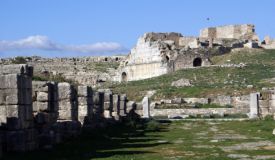
Miletus was one of the most important Ionian cities in the region. Located at the mouth of the Meander (Büyük Menderes) River, Miletus was a rich trade center. Although the four ports of the city have been silted up by the Meander River, causing the city to lie at a distance of several kilometers from the shore today, by using these strategic ports, Milesians managed to build colonies in the Marmara and Black Sea regions successfully.
Due to this wealth and power, Miletus reached its golden era as early as the 6th century BC. During these golden years, Miletus produced very important philosophers, geographers, and mathematicians like Thales, Anaximenes, Anaximander, and Hecataeus.
After being under the control of the Persians around the 4th century BC, Miletus became part of the Roman Empire around 130 BC. Miletus features solid and original examples of ancient city planning and architecture that were applied by the great architect Hippodamus.
But probably the most famous architect of the Miletus design school and architectural heritage is Isidore of Miletus, who blueprinted the rebuilding of the church of Hagia Sophia in Istanbul in the 6th century AD.
Miletus was settled as early as the Bronze Age (c. 3000 BC).
It became a leading Ionian city in the 8th-6th centuries BC.
The Milesian school (Thales, Anaximander, Anaximenes) founded Western philosophy and science.
Miletus founded over 90 colonies throughout the Mediterranean and Black Sea.
The Persians destroyed the city in 494 BC after the Ionian Revolt.
Alexander the Great reconquered Miletus in 334 BC, beginning a new era.
The city became part of the Roman Empire in 130 BC.
Miletus continued as an important Byzantine city but declined as its harbors silted up.
The Meander River gradually filled the harbors, leaving the ruins inland.
Thales (c. 624-546 BC) is considered the first Western philosopher.
He predicted a solar eclipse and proposed that water was the fundamental substance.
Anaximander (c. 610-546 BC) proposed the concept of the "apeiron" (infinite).
He created one of the first maps of the known world.
Anaximenes (c. 586-526 BC) proposed that air was the fundamental substance.
Hecataeus (c. 550-476 BC) was a geographer and historian.
He improved upon Anaximander's map and wrote a world geography.
Isidore of Miletus (c. 6th century AD) was a renowned architect and mathematician.
He was one of the two architects of Hagia Sophia in Constantinople (Istanbul).
Emperor Justinian I commissioned him and Anthemius of Tralles to design the church.
Hagia Sophia was completed in just five years (532-537 AD).
Isidore was also a professor of geometry at the University of Constantinople.
He wrote a commentary on the works of Hero of Alexandria.
His nephew, Isidore the Younger, continued his work on Hagia Sophia after an earthquake.
The Great Theater: One of the largest theaters in Anatolia, seating over 15,000 people. The theater dates from the Hellenistic period and was expanded by the Romans. It has been partially restored.
Faustina Baths: Built by Emperor Marcus Aurelius in honor of his wife, Faustina. The baths are remarkably well-preserved, with walls still standing several meters high. You can see the heating system (hypocaust) and the layout of the bathing chambers.
The Delphinium: A sanctuary dedicated to Apollo Delphinius. Includes an altar and inscriptions.
The Bouleuterion: The council house where the city assembly met. A small theater-like structure.
The Agora: The central marketplace. Surrounded by stoas (covered walkways) and shops.
The Harbor Monument: A monumental gateway from the Roman period, once marking the entrance to the north harbor.
The Ilyas Bey Mosque: A 15th-century Ottoman mosque built using stones from the ancient city. Located near the entrance.
Entrance Fee: Approximately 100-150 TL (separate from Didyma and Priene). Museum Pass Turkey is accepted.
Opening Hours: Daily 8:30 AM to 7:00 PM (summer), 8:30 AM to 5:00 PM (winter).
Best time to visit: Spring (April-June) and autumn (September-October) offer mild weather. Summer (July-August) is very hot (35-40°C). Visit early morning or late afternoon. The site is large and has limited shade.
How to get there: Miletus is located about 20 km north of Didyma (Didim), 100 km from Kuşadası (1.5 hours), and 160 km from Bodrum (2.5 hours). The best way to visit is by rental car or with a guided tour. Minibuses (dolmuş) from Didim to Miletus are infrequent. You can also use a private Izmir Airport Transfer or Bodrum Airport Transfer.
What to bring: Water, sunscreen, hat, and comfortable walking shoes. The site is large and spread out.
Facilities: A small cafe and gift shop near the entrance. Toilets are available.
You can access these three sites from Kuşadası (about 100 km) or Bodrum (about 160 km). Tours from Istanbul and daily tours from Izmir are also available.
Please see our tour page for all tours in this region and around Turkey.