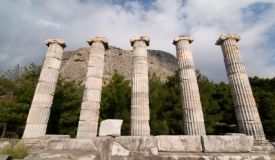
Priene, a smaller site compared to Miletus, located 45 km from Didyma, was once a harbor city with two ports. It shared the same destiny with Miletus due to alluviums carried by the Meander River. The Ionian settlement began in the 11th century BC, but the city was rebuilt during the 4th century BC. Signatures of Hippodamus of Miletus can be seen regarding the town-planning features.
The most important structure in Priene is the Temple of Athena. You can also see the Temple of Zeus, Temple of Demeter, the theater, and the stadium.
Priene was founded as an Ionian Greek city in the 11th-10th centuries BC.
The original city was located on the coast, with two harbors.
The Meander River gradually silted up the harbors, leaving the city inland.
The city was rebuilt in the 4th century BC (c. 350 BC) on the slopes of Mount Mycale.
The new city followed the Hippodamian grid plan, with streets intersecting at right angles.
The city was enclosed by defensive walls.
Priene was never a large city, but it was prosperous and culturally significant.
The city was a member of the Ionian League.
Priene continued under Roman and Byzantine rule but declined after the 7th century AD.
Hippodamus of Miletus (c. 498-408 BC) was an ancient Greek architect and urban planner.
He is considered the "father of urban planning."
The Hippodamian plan features a grid of streets intersecting at right angles.
The plan includes designated zones for public, private, and religious buildings.
The grid plan at Priene is still clearly visible in the streets and house foundations.
The main streets ran east-west, with narrower streets running north-south.
The agora (marketplace) was located in the center of the city.
Temple of Athena: The most important structure in Priene. The temple was built in the 4th century BC (c. 340-330 BC). It was a small but elegant Ionic temple. The architect was Pytheos, who also designed the Mausoleum at Halicarnassus (one of the Seven Wonders of the Ancient World). The temple was excavated by the Germans, and some of the finds are in the Pergamon Museum in Berlin. The view from the temple over the Meander plain is spectacular.
The Theater: One of the best-preserved theaters in Anatolia. Built in the 4th-3rd centuries BC. Capacity of about 5,000-6,000 people. The theater is carved into the hillside. The stage building is well-preserved.
The Agora: The central marketplace of Priene. Surrounded by stoas (covered walkways). The sacred stoa on the north side was two stories high.
The Bouleuterion: The council house where the city assembly met. A small theater-like structure with a capacity of about 640 people. Remarkably well-preserved.
The Temple of Zeus: Located near the agora. A small temple in the Doric style.
The Temple of Demeter: Located on the lower slopes of the acropolis. Dedicated to Demeter, goddess of agriculture. Includes a rock-cut altar.
The Stadium: Located outside the city walls. Used for athletic competitions. Modest in size, reflecting the city's small population.
The Acropolis: The highest point of the city, defended by walls. No major structures remain, but the views are excellent.
Entrance Fee: Approximately 100-150 TL (separate from Didyma and Miletus). Museum Pass Turkey is accepted.
Opening Hours: Daily 8:30 AM to 7:00 PM (summer), 8:30 AM to 5:00 PM (winter).
Best time to visit: Spring (April-June) and autumn (September-October) offer mild weather. Summer (July-August) is very hot (35-40°C). Visit early morning or late afternoon — the site is on a hillside with limited shade. The afternoon light is excellent for photography.
How to get there: Priene is located about 45 km north of Didyma (Didim), 100 km from Kuşadası (1.5 hours), and 160 km from Bodrum (2.5 hours). The best way to visit is by rental car or with a guided tour. The road up to the site is winding but well-maintained. You can also use a private Izmir Airport Transfer or Bodrum Airport Transfer.
What to bring: Water, sunscreen, hat, and comfortable walking shoes. The site is on a hillside and requires some uphill walking.
Facilities: A small cafe near the parking area. Toilets are available. The site has limited shade, so bring your own water.
You can access these three sites from Kuşadası (about 100 km) or Bodrum (about 160 km). Tours from Istanbul and daily tours from Izmir are also available.
Please see our tour page for all tours in this region and around Turkey.