
Pamukkale travertines
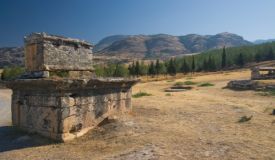
Necropolis at Hierapolis, Pamukkale

Pamukkale travertines overlooking the valley
It is one of the UNESCO World Heritage Sites meaning "Cotton Castle" in Turkish. You will understand the reason behind this sweet name when you see the breathtaking white travertines built by carbonate minerals carried by hot water which springs from the plateau where Pamukkale stands. It is one of the most important stops for all visitors traveling to Turkey. As it is located at 19 km from a modern day Turkish city, Denizli, and since it is easily accessible, tours from Istanbul, Izmir and some other destinations are available all year long. Night stops are no problem. There are many hotels in Pamukkale to accommodate visitors coming from all over the world.
This beautiful example of a natural spa center once known as the city of Hierapolis which was built around 200 BC by Eumenes II, the King of Pergamon, later became a Roman thermal bath center city. Today the ruins of Hierapolis lies above the travertines that overlook the magnificent Curuksu valley at an altitude of 360 meters. The whole structure which has been formed through thousands of years stands like a fairy tale waiting to be touched, examined and enjoyed. It is also believed that the hot water springs of Pamukkale have some curing and beautifying powers but just don't get carried away with the amazing looks of the travertines, there is lot to see in Hierapolis too:
The sacred pool lies on the hot water source supplying the carbonate minerals to the travertines. It means it is a historical swim on top of a pool base which consists of two thousand years old ruins, marble columns and stones.
Necropolis the city of death, the best preserved cemetery containing thousands of graves. Being a holy city, Hierapolis was also a great graveyard for the people who wanted to spend their last days in the thermal center. Their last wish was to be buried there.
The Colonnade street, the main street of Hierapolis which is a mile long and is designed to feature precise intersection points, a good evidence for the city planning ability of these people, helps us to visualize the deep, rich, colorful history of this holy city.
Roman theater with a seating capacity of 10,000 that was built by Emperor Hadrian in 2nd century AD. It can compete with the one of Ephesus and some claim it has better acoustics.
To get to Ephesus from Pamukkale you can use bus and local minibus services or use a private Izmir Airport Transfer.
To know where Pamukkale sits in the timeline of Anatolia's (Modern Turkey) ancient history please see History of Anatolia
The travertines are now protected. You cannot walk on all sections — designated paths preserve the calcium deposits. Shoes are not allowed on the white terraces; you must walk barefoot. The water flow is managed seasonally, so some pools may be dry depending on when you visit. Early morning (before 9 AM) and late afternoon (after 4 PM) are the best times for photography and to avoid crowds.
The ancient pool (Cleopatra's Pool) requires a separate entrance fee beyond the main site ticket. Lockers and changing rooms are available for a small fee. The water is thermal, around 36°C all year.
Pamukkale is the name of the white travertine terraces. Hierapolis is the ancient Roman city built on top of them. Most visitors think of the whole area as "Pamukkale," but you are actually visiting both: the natural wonder (travertines) and the archaeological site (Hierapolis ruins). The combined ticket covers both.
Pamukkale is located 19 km from Denizli, which has an airport with flights from Istanbul. From Denizli Airport, a taxi or shuttle takes about 30 minutes. From Izmir, the drive is about 3 hours. From Kusadasi or Selçuk (Ephesus), it is 2.5 to 3 hours. Many visitors combine Pamukkale with Ephesus on a 2-day tour from Istanbul or Izmir.
Morning (9:00 AM - 12:00 PM): Start at the lower entrance. Walk up the travertines barefoot (bring a bag for your shoes). Take your time — the terraces are slippery. Reach the top and enter Hierapolis.
Midday (12:00 PM - 2:00 PM): Visit the Roman theater, the Colonnade street, and the Necropolis. Lunch at the cafe near the museum or the restaurant by Cleopatra's Pool.
Afternoon (2:00 PM - 4:00 PM): Swim in Cleopatra's Pool (extra fee) among ancient columns. Visit the Hierapolis Archaeology Museum (housed in the old Roman baths). Walk back down through the travertines or take the road to the lower exit.