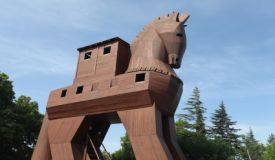
Trojan horse replica, Troy

Entrance to city of Troy
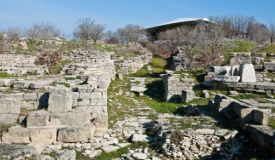
Ruins of Troy
Forever eternal now by the efforts of great Homer in his Illiad and Odyssey, Troy which is located at around 350 km south-west of Istanbul is an ancient city of legends, wars, controversies and unknowns. It was in fact discovered by Heinrich Schliemann, who was obsessed by ancient Greece and who was determined to find the city of Troy where the Trojan War was held, mentioned skilfully in Homer's chef-d'oeuvre.
Despite the treasure he has found and happily smuggled out of the country ( Ottoman Empire back then) , there is no concrete evidence that this place found by him in 1870, is the Troy of Homer that witnessed Helen, King of Priam, Paris, the Trojan Horse and the Trojan War. However it does not eclipse the importance of this ancient site that contains 9 civilizations built on top of each other. Although the famous treasure of Troy which consists of jewelry mainly in gold and silver is now somewhere else, half missing by the way, Troy is so important and so promising in terms of ancient Anatolian history that the excavation still continues without any indication of an end.
The first Troy dates back to 3000 BC and it is the Troy I from default. The ruins of Troy, located at 30 km from modern day Turkish city of Canakkale, near a small village called Hisarlik, contain roughly 9 different layers of settlements which consist of various phases in themselves as in Troy IIb or Troy IVc etc. Each of these layers, phases or time capsules, if you like, indicate different eras. So which layer was the city of Troy told by Homer? As usual, no general agreement exist on that however, it is believed that it is either phases VIh or VIIa.
For those of you who are wondering in which layer Schliemann had found the treasure stands an ironic answer. That was the Troy II. So he thought that the treasure he had found must have belonged to King Priam of Illiad and Odyssey but he was wrong.
The importance of Troy comes from its strategic location. It was in fact a port city located beside Mount Ida and at the entrance of Dardanelles which is only 1.5 km wide. Any army or group coming from North with an idea of crossing the Dardanelles and intention of stepping on to Anatolia in their minds had to deal with Troy first. That is one of the reasons why we see so many civilizations built, literally swept away and re-built again in Troy. Also, the sea trade between Aegean and Black Sea was completely under control of Troy and because of this important advantage, they were able to build relations with two important cultures of their time: Hittites and Greeks.
Today, we know that the colonization of Western Anatolia by ancient Greeks started in Troy and the city kept its momentum until the Eastern Roman Empire established a new capital called Constantinople by the 4th century BC. The city lost its spark and slowly vanished while history was shining an all new city of trade at Bosphorus, possessing bigger and much, much more valuable treasures compared to the treasure of King Priam. But that's another story.
Troy can be reached either from Istanbul or Canakkale and daily tours are always available from these cities.
To know where Troy sits in the timeline of Anatolia's (Modern Turkey) ancient history please see History of Anatolia
The site has a large visitor center with exhibits explaining the nine layers of Troy. The wooden Trojan Horse replica at the entrance is a modern addition, but it makes for an excellent photo. The new museum near the excavation houses many of the artifacts found on site, including the famous "Treasure of Troy" replicas (the originals are in the Pushkin Museum in Moscow and the Pergamon Museum in Berlin).
The site is well signposted with walking paths. Plan 1.5 to 2 hours to see the main features: the fortified city walls, the ramp, the megaron, the larger houses of Troy II, the theater, and the Odeon. The path is mostly gravel and packed earth; wear comfortable walking shoes.
Troy is located 30 km south of Canakkale, near the village of Hisarlik. From Canakkale, minibuses (dolmus) run regularly from the town center to the Troy site — the ride takes about 40 minutes, and drivers drop you at the entrance. From Istanbul, the drive is approximately 5 hours (350 km). Many visitors combine Troy with Gallipoli in a 2-day tour from Istanbul.
If you have only one day, choose based on your interest. Gallipoli is a WWI battlefield with cemeteries and memorials — emotional and historically important in modern history. Troy is an ancient Bronze Age city with 9 layers of civilization — legendary and archaeological. They are only an hour apart by car, so most travelers visit Troy in the morning and Gallipoli in the afternoon, or vice versa.
Morning (10:00 AM - 12:30 PM): Arrive at Troy. Start at the visitor center for an overview of the nine layers. Walk the site: see the Trojan Horse replica, the city walls, the ramp, the megaron (royal house), and the Odeon. The path is a loop returning to the entrance.
Afternoon (12:30 PM - 2:00 PM): Lunch at the small cafe near the entrance or bring a picnic. Visit the Troy Museum (across from the site entrance) — a modern, world-class museum with remarkable artifacts found during excavations.
Late Afternoon: If time allows, drive the 30 km north to Canakkale to see the waterfront and the Trojan Horse replica used in the film "Troy" (the one at the site entrance is a different replica).