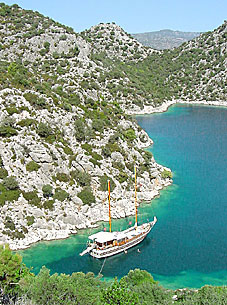
Turkey's land mass is 783,562 sq km (approximately 302,535 sq miles). Anatolia is a high plateau region rising progressively towards the East, and is broken by the valleys of about fifteen rivers. There are numerous lakes; and the greatest lake Van is larger than some inland seas. In the North, the Eastern Black Sea Mountain chain runs parallel to the Black Sea; in the South, The Taurus Mountains sweep down almost to the narrow, fertile coastal plain along the sea coast.
The coastline of Turkey's four seas is over 8,333 km long.
Turkey enjoys a variety of climates changing from the temperate and rainy climate of Black Sea to the continental climate of the interior, then, to the Mediterranean climate of the Aegean and the Mediterranean Coastal regions.
Summers are hot, springs are warm and winters are usually cold or cool. Autumn is nice for the entire duration of September and October. Then the weather starts to cool down.
The above is what you should expect normally. However global climate changes, as you may have noticed in your own country, can affect seasonal patterns.
The Turkish Republic is based on a secular parliamentary system.
Agriculture plays an important role in Turkish economy. Turkey is one of the most important food exporters in the world. The main crops are wheat, rice, cotton, tea, tobacco, hazelnuts and fruits. Sheep are Turkey's most important livestock. Turkey is one of the greatest wool and cotton producers in Europe.
Industrial goods have also come to play an important role in the economy bringing the economic growth to a higher ratio, from white goods to cars.
Turkey has become a major touristic destination in Europe. With the rapid development of summer and winter tourism facilities, people from all over the world are able to enjoy the cultural, historical and natural sites of Turkey.
Turkey has approximately 85 million inhabitants. About 99% of the population are Muslim. Istanbul is the greatest city having over 15 million inhabitants.
Turkish society was modernized after the revolutions and reforms of Atatürk — the founder of Turkey. Westernization is high in cities but traditions of Turkey are different from the West. People in the countryside are more conservative and traditional.
Hospitality is one of the cornerstones of the Turkish way of life. Every Turkish person feels bound to honour his guest in the best possible manner.
12 years of primary, middle and high school is compulsory for children. After high school, universities and private colleges are available.
Turkey has been using the Latin alphabet since 1928. Here is a guide for small conversations:
| English | Turkish | Numbers | Turkish |
|---|---|---|---|
| Yes | Evet | 0 | sıfır |
| No | Hayır | 1 | bir |
| Please | Lütfen | 2 | iki |
| Hello | Merhaba | 3 | üç |
| Thanks | Sağol / Teşekkür ederim | 4 | dört |
| Pardon / Excuse me | Pardon / Affedersiniz | 5 | beş |
| Good morning | Günaydın | 6 | altı |
| Good evening | İyi akşamlar | 7 | yedi |
| Good night | İyi geceler | 8 | sekiz |
| Hospital | Hastane | 9 | dokuz |
| Airport | Havaalanı | 10 | on |
| Restaurant | Lokanta / Restoran | 20 | yirmi |
| Water | Su | 30 | otuz |
| Wine | Şarap | 40 | kırk |
| Breakfast | Kahvaltı | 50 | elli |
In hot times of the year (June to mid-September) of Marmara, Aegean, and Mediterranean — take light, cotton summer clothing and a cardigan for the evening.
In hot times of the year (June to mid-September) of Black Sea, Central and Eastern Anatolia — besides summer wear, warmer clothing should be taken for cool evenings at high altitudes.
In winter, woolens and rain gear are needed. Most of the country is cold and rainy. High Central and Eastern Anatolia are mostly snowy. The Mediterranean coast does not get very cold.
Comfortable shoes are necessary for visiting archaeological and historical sites.
The national monetary unit is the Turkish Lira (TRY). Inflation has been a challenge, but the government takes measures to stabilize prices. Exchange rates for foreign currencies fluctuate.
In cheap restaurants and hotels, tipping may not be necessary. In expensive restaurants, hotels and hairdressers, tipping is customary (around 10%).
Post offices are easily recognizable by their yellow 'PTT' signs. Major post offices are open 08:00 - 24:00, Monday to Saturday; 09:00 - 19:00, Sunday. Smaller offices follow government hours: 09:00 - 12:30, 13:30 - 17:00. Choose express mail (APS) for the fastest service within Turkey.
There are hundreds of local and national private TV and radio channels in Turkey as well as the government-dependent channel TRT. On TRT, short news bulletins are given in English, German and French in the evenings. International channels like CNN, BBC, and Eurosport are also available.
Electricity is supplied at 220 volts. Plugs have two round prongs (Type F, same as most of Europe).
Most hotels have laundry services. The reception will help you. Automatic laundries are common in many touristic cities.
Bottled water is suggested. Tap water is safe in most cities but heavily chlorinated. In rural areas, stick to bottled.
Doctors and dentists can be found in Turkish major hospitals and clinics. In addition, there are certain foreign-operated hospitals in Istanbul and other big cities. Modern healthcare at international standards can be found in Istanbul, Ankara, Izmir, Antalya and some resort towns.
Smoking is forbidden by Turkish law in closed public areas (such as buses, restaurants, bars). Most Turkish adults smoke, but thanks to this law, secondhand smoke is much less of an issue than in the past.
Government offices: 8:30 - 17:30 (12:30 - 13:30 noon break). Shops: 9:00 - 19:00 (13:00 - 14:00 noon break). Tourist shops in resorts stay open much later.
Religious festivals such as Ramadan (Ramazan) and Eid al-Adha (Kurban Bayramı) are also official holidays. Since these follow the Islamic calendar, their dates change every year (about 10-12 days earlier each year). During these holidays, many businesses close, and domestic travel is very busy.
Wrestling was Turkey's traditional sport, but the most popular sport today is football (soccer), followed by basketball. Other sports practiced around the country include underwater diving, windsurfing, golf, air sports, caving, hunting, winter sports, mountaineering, and trekking.
For events in Istanbul, please see our Events in Istanbul page.
Turkish Carpets — Carpet weaving is traditional in Turkey. Turkish carpets are famous for their beauty and durability. They are the most important shopping item for foreign visitors. Carpets from other countries such as Iran, Uzbekistan, and Azerbaijan are also widely available.
Ceramics — Ceramics made in Kütahya and İznik are unique and well-known. Handmade tiles, plates, cups, and bowls are very decorative and interesting.
Copper Vessels — One of the most purchased antique-like decorative goods by foreigners. Coppersmithing was traditional in the Ottoman Empire.
Jewellery — Gold and silver are widely available.
Leather — A major industry in Turkey. Leather shoes, bags, cushions, jackets, hats, and trousers are attractive and good value.
Meerschaum — A hydrous magnesium silicate (a clay-like material) carved into pipes. A unique material found in Eskişehir. Beautiful pipes carved from this stone are highly recommended for use or as decorative items.